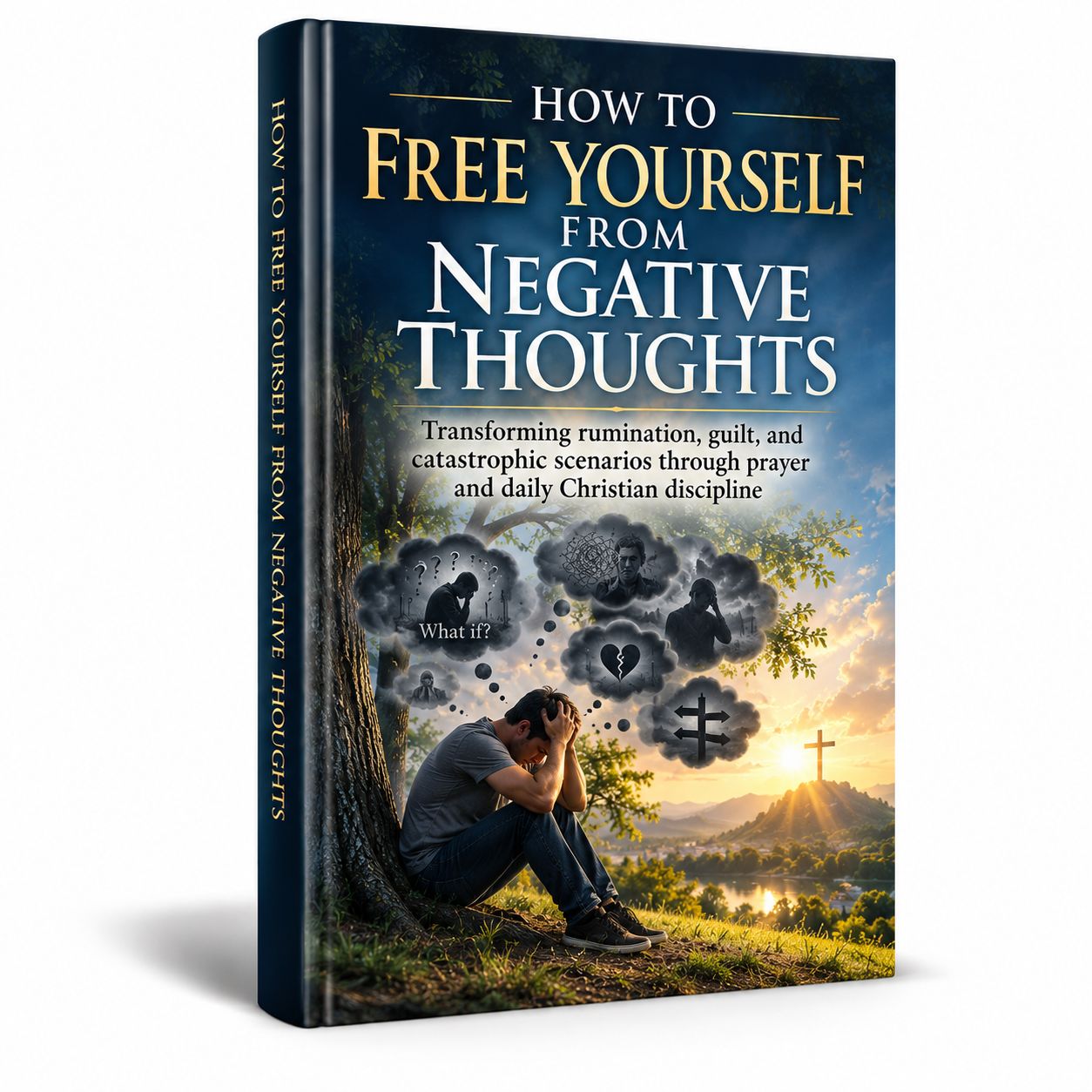
What If Your Negative Thoughts No Longer Had the Power to Control Your Life?
Discover how to break the cycle of overthinking, guilt, fear, and catastrophic thinking through a practical Christian approach based on prayer, the Word of God, and daily discipline.
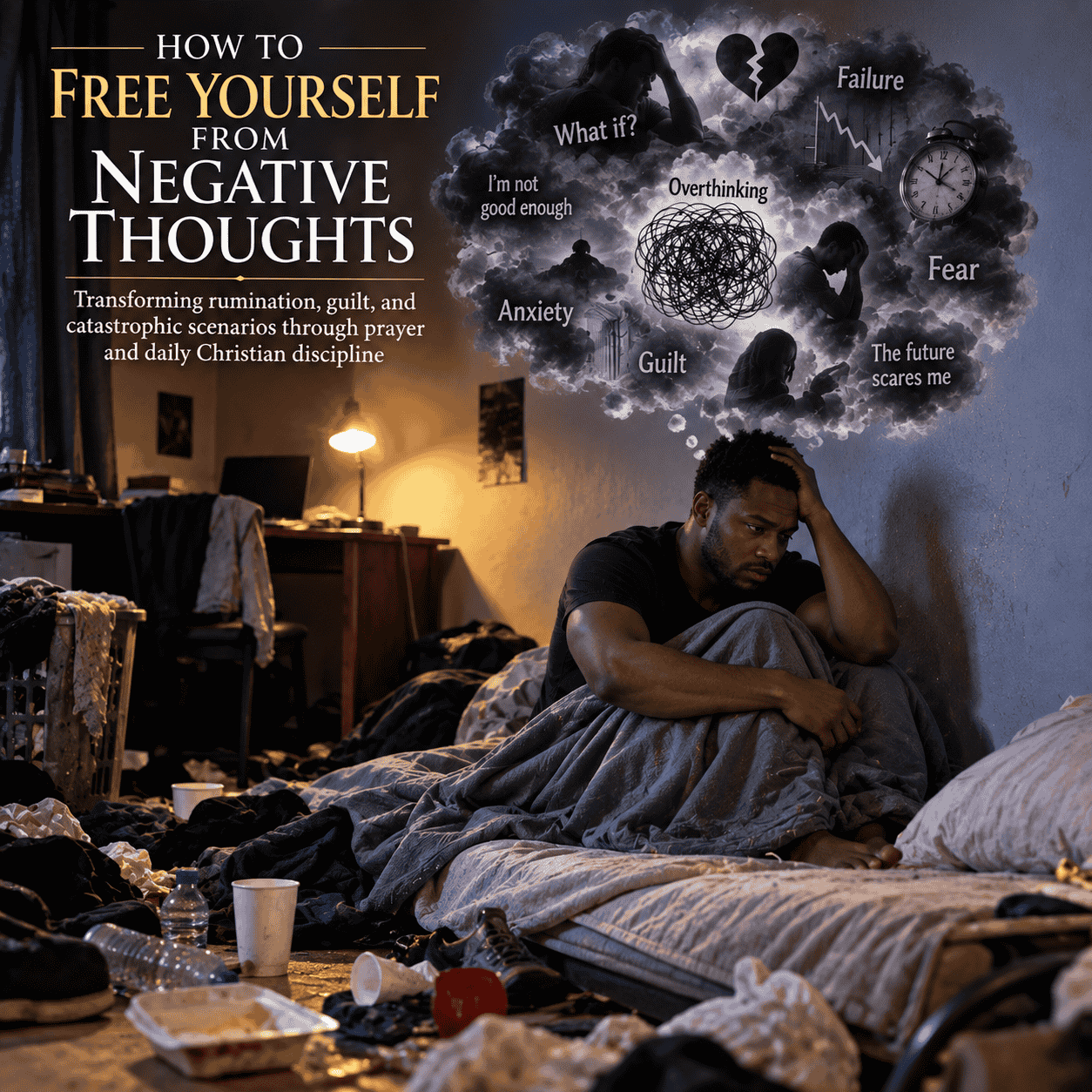
Are You Tired of Thinking… While Your Mind Refuses to Slow Down?
On the outside, everything may seem fine.
But inside, your mind is constantly racing.
You replay conversations.
You analyze past mistakes.
You question your decisions.
You imagine everything that could go wrong.
You worry about tomorrow.
And the questions keep coming:
“What if things go wrong?”
“What if I had done things differently?”
“What if something happens?”
“Why did I say that?”
“What if God doesn’t help me?”
You try to distract yourself.
You pray.
You tell yourself to stop thinking about it.
But a few hours later…
The thought comes back.
And sometimes, it feels even stronger than before.
The problem is not necessarily that you lack faith.
The problem may be that you were never taught how to practically respond to the thoughts that overwhelm your mind.
Why Does Your Mind Keep Going in Circles?
When the same thought is repeated again and again, it can become a deeply rooted mental pattern.
And before you realize it, your thoughts begin influencing your emotions, your decisions, your relationships, and your daily peace.
You may find yourself:
❌ Constantly replaying past mistakes
❌ Automatically imagining the worst-case scenario
❌ Struggling to stop the endless “What if?” thoughts
❌ Feeling guilty even after asking God for forgiveness
❌ Doubting your decisions over and over again
❌ Struggling to enjoy the present moment
❌ Wanting to trust God while your mind keeps feeding your fears
❌ Knowing that certain thoughts are hurting you, but not knowing how to interrupt them
And the more desperately you try to control every thought…
the harder it can seem to calm your mind.
✅ The Solution: How to Free Yourself from Negative Thoughts
How to Free Yourself from Negative Thoughts is a practical Christian guide designed to help you understand what is happening in your mind and learn how to respond differently.
This is not simply about “thinking positively.”
It is about learning, step by step, how to:
- Recognize negative thought patterns
- Understand why certain thoughts take up so much space in your mind
- Interrupt cycles of rumination and overthinking
- Deal with guilt and the weight of the past
- Challenge catastrophic thinking
- Return to biblical truth when fear takes over
- Use prayer as a daily response to anxiety and negative thoughts
- Replace fear-driven reactions with faith-filled responses
- Build a daily Christian discipline that supports a more peaceful mindset
You will not simply be told to “stop thinking negatively.”
You will learn practical ways to respond when negative thoughts appear.
🎯 From This Situation…
You wake up already feeling mentally overwhelmed.
You replay yesterday’s mistakes.
You imagine everything that could go wrong tomorrow.
You criticize yourself for things you cannot change.
You pray, but you still don't know what to do when the thoughts return.
You want to trust God…
but your mind keeps returning to fear.
🎯 To This Ideal Situation…
You begin recognizing negative thoughts instead of automatically believing them.
You learn how to interrupt destructive mental loops.
You understand the difference between constructive conviction and destructive condemnation.
You learn how to face uncertainty without automatically assuming the worst.
You develop a practical habit of returning to Scripture and prayer.
You begin responding to difficult thoughts with:
Truth. Faith. Wisdom. Discernment. Peace.
The goal is not to pretend that difficult thoughts will never appear.
The goal is to stop allowing every thought to control your response.
📖 WHAT YOU WILL DISCOVER INSIDE THE GUIDE
01 — Understanding the Battle in Your Mind
Learn what happens inside your mind when negative thoughts begin to take over.
You will explore:
- Where negative thoughts come from
- The connection between thoughts, emotions, and actions
- Why certain thoughts feel so real
- Destructive thought patterns
- The difference between a thought and the truth
- The spiritual dimension of the battle in your mind
02 — Understanding How Negative Thoughts Gain Power
Why does a thought become stronger the more you think about it?
Discover how repetition can reinforce mental patterns and how fear, self-talk, and emotional reactions can create a cycle that becomes difficult to break.
You will learn how to recognize the pattern before it begins controlling you.
03 — Breaking the Cycle of Rumination
Do you constantly replay the past?
Do you analyze conversations, mistakes, decisions, and situations over and over again?
This section helps you understand:
- What rumination really is
- Why your mind keeps replaying the past
- The dangerous “What if?” trap
- Why overthinking does not always produce answers
- How to interrupt mental loops
- How to let go of what you cannot change
- A practical anti-rumination routine
04 — Breaking Free from Guilt and the Weight of the Past
Some people ask God for forgiveness…
but continue punishing themselves mentally.
Learn the difference between:
Conviction and condemnation.
Repentance and self-punishment.
Learning from the past and living in the past.
Discover how to receive God's grace, release destructive shame, and move forward without carrying yesterday into every new day.
05 — When Fear Creates Catastrophic Scenarios
Fear can make your mind predict a future that has not even happened.
One small possibility becomes a disaster in your imagination.
You will learn how to:
- Recognize catastrophic thinking
- Understand why your mind automatically imagines the worst
- Separate possibility from reality
- Challenge “What if?” thinking
- Make decisions without allowing fear to lead
- Face uncertainty with wisdom
- Trust God with what you cannot control
06 — Renewing Your Mind Through the Word of God
Your mind needs truth.
This section explores how Scripture can become part of your daily mental discipline.
You will discover practical applications based on passages such as:
- Romans 12:2 — The renewal of the mind
- Philippians 4:8 — Choosing what to focus on
- 2 Corinthians 10:5 — Taking thoughts captive
You will learn how to identify destructive beliefs and replace them with biblical truth.
07 — The Power of Prayer Over Negative Thoughts
What do you do when your mind will not slow down?
Instead of allowing panic to dictate your response, learn how to bring your thoughts honestly before God.
You will explore prayers for:
- Worry and fear
- Guilt and shame
- The future
- Difficult decisions
- Mental peace
- Trusting God
You will also learn how to build a consistent daily prayer routine.
08 — Learning to Capture and Challenge Your Thoughts
Not every thought deserves to be believed.
Learn how to stop and ask:
“Is this thought actually true?”
You will learn how to identify:
- Exaggerations
- Assumptions
- Fear-based conclusions
- Negative self-talk
- Unnecessary mental predictions
Then you will practice replacing destructive thoughts with truth and creating a healthier mental response.
09 — Replacing Fear with Faith
Fear says:
“What if everything goes wrong?”
Faith says:
“I don't know what tomorrow holds, but I know Who holds tomorrow.”
Discover what biblical faith really means.
You will learn how to trust God without ignoring reality, face uncertainty with courage, surrender what you cannot control, and make everyday decisions from a place of faith rather than fear.
10 — Building a Daily Christian Discipline
Freedom is not only about what you do when your mind is overwhelmed.
It is also about what you practice every day.
You will learn how to create a simple Christian routine involving:
- Morning time with God
- Prayer
- Scripture
- Gratitude
- Reflection
- Healthy mental boundaries
- Protection from negative influences
- Ending your day in peace
11 — What to Do When Negative Thoughts Return
What happens when you thought you had overcome something…
and suddenly the same thoughts come back?
You will learn why old patterns can return and why a setback does not mean you have failed.
Discover how to:
- Respond when fear suddenly returns
- Avoid feeding negative thoughts
- Recognize your triggers
- Return to Scripture and prayer
- Strengthen your new mental habits
- Begin again without condemning yourself
12 — Creating a Peace-Filled Mindset
Inner peace is not the absence of difficult circumstances.
It is learning how to respond to them differently.
You will discover how to:
- Train your attention
- Choose what deserves your mental energy
- Practice gratitude
- Establish healthy mental boundaries
- Surround yourself with truth and encouragement
- Develop peaceful responses to difficult situations
- Protect the peace you are building
💎 THE UNIQUE BENEFITS OF THIS GUIDE
A Christian AND practical approach
This guide combines biblical principles with practical exercises and daily applications.
A clear step-by-step structure
You don't have to figure everything out on your own. The guide takes you through the process progressively.
Focused on real struggles
Rumination.
Guilt.
Fear.
Overthinking.
Catastrophic scenarios.
Negative self-talk.
Difficulty finding peace.
Designed for daily practice
The goal is not simply to read.
It is to practice.
A 30-Day Christian Plan
The guide includes a structured 30-day plan to help you put what you learn into practice day after day.
A resource you can return to
When difficult thoughts come back, you can return to the relevant chapter, exercise, prayer, or biblical principle instead of starting from zero.
🚀 TAKE ACTION NOW
Without a clear approach, the cycle can look like this:
Thought → Worry → Analysis → Fear → New Thought → More Analysis → More Worry
But with a structured approach, you can learn to create a different response:
Thought → Observation → Truth → Prayer → Discernment → Conscious Response
You may not be able to control every thought that enters your mind.
But you can learn to become more intentional about which thoughts you believe, how you respond to them, and where you direct your mind.
If you are ready to stop allowing rumination, fear, guilt, and catastrophic thinking to dominate your inner life…
If you want to deepen your relationship with God while developing practical habits for dealing with difficult thoughts…
If you want a guide you can actually use in your everyday life…
This guide was created for you.
👉 Download “How to Free Yourself from Negative Thoughts” now
and begin breaking the cycle of rumination, fear, and guilt while developing a more peaceful mind grounded in faith and the truth of God's Word.
Customer Testimonials
Sarah K.⭐⭐⭐⭐⭐
This guide helped me better understand why I kept going back over my mistakes. I learned how to interrupt negative thoughts and return to the Word of God. It was truly a thought-provoking and meaningful read.
Michael L.⭐⭐⭐⭐⭐
I used to constantly imagine the worst-case scenario. The advice in this guide is simple to understand and easy to apply in everyday life. I now feel much more capable of stepping back and gaining perspective when certain thoughts arise.
Grace A.⭐⭐⭐⭐⭐
I particularly appreciated the practical approach. The guide doesn’t simply tell you to think positively; it shows you how to respond when fear, guilt, or rumination comes back. It was exactly what I needed.
Daniel T.⭐⭐⭐⭐⭐
The chapter on rumination really spoke to me. I could spend hours analyzing a conversation or a decision. I discovered a different way to deal with these thoughts and to place certain things in God’s hands.
Rachel D. ⭐⭐⭐⭐⭐
The section on guilt and the past deeply touched me. I tended to condemn myself long after making a mistake. This guide encouraged me to understand the difference between learning from my past and continuing to live as a prisoner of it.
James A.⭐⭐⭐⭐⭐
I loved the way the guide combines prayer, Scripture, and practical actions. The 30-day plan also provides a great structure for turning what you read into daily practice.
Esther H. ⭐⭐⭐⭐⭐
I could really relate to the catastrophic scenarios my mind constantly created. I learned to distinguish between what is actually happening and what my fear is imagining. This helps me approach certain situations with much more calm.
David T. ⭐⭐⭐⭐⭐
What I appreciated most is that the guide remains simple and practical. I now have a better idea of what to do when negative thoughts return instead of simply allowing them to take over my mind.