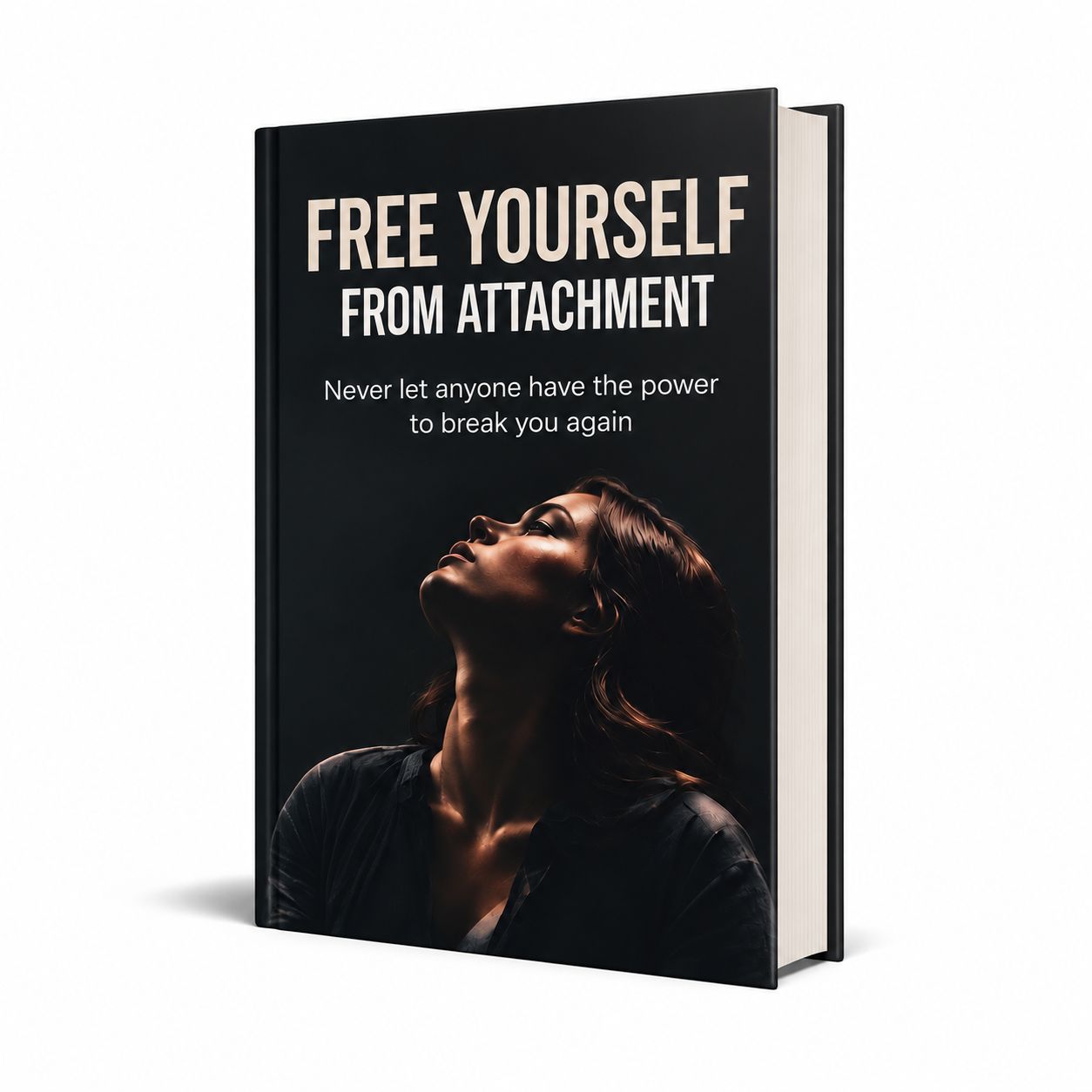
What if the problem isn't that you love too much…
What if you've simply learned to make another person responsible for your emotional security?
Maybe you've experienced that feeling before.
You wake up and the first thing you think about is them.
You check your phone.
Nothing.
You tell yourself not to worry.
Then you check again.
You replay the last conversation in your head.
“Why did they say that?”
“Why are they acting differently?”
“Did I do something wrong?”
“Are they losing interest?”
And even when you know you should step back…
you can't.
You keep hoping.
You keep waiting.
You keep explaining.
You keep giving.
You keep chasing.
Until one day, you realize something painful:
You have spent so much energy trying to keep someone else in your life that you've slowly lost yourself.
If that sounds familiar, you're not weak.
You're not “too emotional.”
And you're certainly not broken.
But you may be trapped in a pattern of emotional attachment that keeps you dependent on someone else's presence, attention, affection, or approval.
And the good news is:
That pattern can change.
❌ Why You Keep Getting Stuck
Emotional attachment can quietly take control of your life.
You may think the solution is to get the person back.
But sometimes, the real solution is to get yourself back.
You may be struggling because:
❌ You confuse love with the fear of losing someone.
❌ You measure your worth by how someone treats you.
❌ You chase people who are emotionally pulling away.
❌ You constantly seek reassurance because you don't feel secure within yourself.
❌ You believe that letting go means giving up on love.
❌ You keep reopening emotional wounds by checking their messages, profiles, or behavior.
❌ You sacrifice your peace to maintain a connection that no longer feels healthy.
❌ You are afraid that being alone means being unwanted.
And the longer this continues, the more difficult it becomes to hear your own voice.
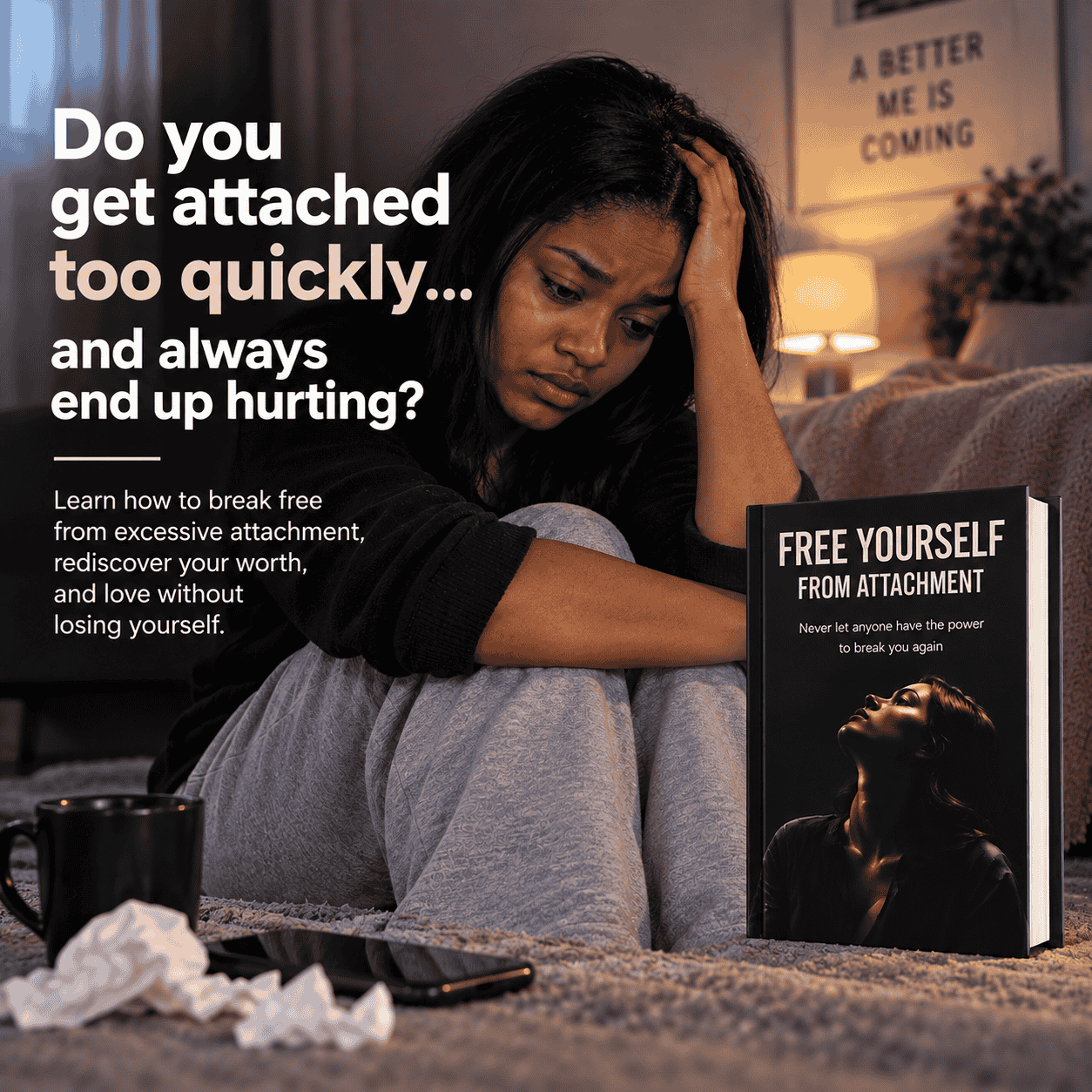
✅ The Solution: FREE YOURSELF FROM ATTACHMENT
You don't need another person to complete you.
You don't need to convince someone to choose you.
And you don't need to become emotionally cold just to protect yourself.
You need to become emotionally grounded.
FREE YOURSELF FROM ATTACHMENT gives you a clear, structured and practical path to understand your attachment patterns, release unhealthy emotional dependence, rebuild your self-worth, and create stronger emotional boundaries.
Instead of simply telling you to “move on,” this guide helps you understand why letting go feels so difficult in the first place.
You'll learn how to stop fighting for people who are choosing distance, stop allowing rejection to define your worth, and rebuild a life in which your emotional stability doesn't depend on another person's behavior.
🎯 From Emotional Dependence → To Emotional Freedom
BEFORE
You constantly wonder where you stand.
→ AFTER: You know your worth even when someone doesn't give you reassurance.
You panic when someone becomes distant.
→ AFTER: You can create space without immediately assuming you're being abandoned.
You chase people who are pulling away.
→ AFTER: You know when to step back and protect your dignity.
You struggle to be alone.
→ AFTER: You become comfortable with your own company.
You keep replaying the past.
→ AFTER: You learn to process the past without living inside it.
You give someone control over your happiness.
→ AFTER: You take responsibility for your own inner peace.
You love by sacrificing yourself.
→ AFTER: You learn to love while maintaining your identity, boundaries and freedom.
📖 What You'll Discover Inside the Guide
This isn't about becoming detached from everyone.
It's about learning how to stay connected without becoming emotionally dependent.
📌 01 — When Attachment Becomes an Invisible Prison
Learn to recognize when caring for someone has quietly turned into emotional dependence.
You'll discover:
- The difference between healthy connection and unhealthy attachment.
- The signs that someone has gained too much emotional power over you.
- Why attachment can feel impossible to break.
- How emotional dependence affects your decisions and self-image.
📌 02 — Why You Become So Attached to Certain People
Not every person affects you in the same way.
Explore the deeper emotional needs that can make certain people extremely difficult to release.
You'll understand:
- Why some connections become emotionally addictive.
- How unmet emotional needs influence attachment.
- Why attention can become difficult to live without.
- How to recognize the patterns behind your strongest attachments.
📌 03 — When Fear of Losing Someone Becomes Anxiety
Sometimes what feels like love is actually fear.
Learn how to separate genuine affection from the anxiety of losing someone's attention.
You'll learn to:
- Recognize fear-driven behaviors.
- Stop interpreting every change in communication as rejection.
- Reduce the need for constant reassurance.
- Create emotional security from within.
📌 04 — Stop Looking for Your Worth in Other People's Eyes
Your value shouldn't rise and fall according to someone else's attention.
This section helps you rebuild a stronger internal sense of worth.
You'll discover:
- Why external validation is so powerful.
- How rejection can damage your self-image.
- How to stop asking, “Why wasn't I enough?”
- How to build self-respect that doesn't depend on someone else's approval.
📌 05 — Accept That Some People Are Not Meant to Stay
One of the hardest lessons in life is accepting that some relationships have an ending.
You'll learn how to:
- Accept endings without seeing them as personal failure.
- Stop trying to force relationships to survive.
- Understand that someone's departure doesn't erase your value.
- Make peace with what you cannot control.
📌 06 — How to Let Someone Go Without Stopping Yourself From Loving
Letting go doesn't mean your feelings suddenly disappear.
It means you stop allowing those feelings to control your life.
You'll discover:
- How to release someone with dignity.
- How to process missing someone without contacting them.
- How to stop feeding emotional attachment.
- How to honor what you felt while still moving forward.
📌 07 — Stop Chasing People Who Are Walking Away
If someone repeatedly creates distance, chasing harder rarely creates the security you're looking for.
Learn how to replace pursuit with:
- Clarity.
- Self-respect.
- Emotional boundaries.
- Healthy distance.
- Acceptance.
- Dignified decisions.
Instead of asking, “How can I make them stay?”
you begin asking:
“Is this relationship still good for me?”
📌 08 — The Power of Silence, Distance and Not Reacting
Not every emotion requires an immediate reaction.
Learn how to create healthy space so you can think clearly instead of acting from fear.
You'll learn:
- When silence can protect your peace.
- How distance can help you regain perspective.
- How to stop reacting impulsively.
- How to respond from self-respect instead of emotional panic.
📌 09 — Relearning How to Be Well Alone
Being alone and feeling abandoned are not the same thing.
This section helps you transform solitude from something you fear into something you can use to reconnect with yourself.
You'll discover how to:
- Enjoy your own company.
- Rebuild your independence.
- Stop needing constant attention.
- Create a life that feels meaningful without a relationship.
📌 10 — Rebuilding Your Identity After Emotional Attachment
Sometimes attachment doesn't only affect your emotions.
It changes who you are.
You may have neglected your goals, friendships, passions, routines or ambitions.
This section helps you:
- Reconnect with your identity.
- Rebuild forgotten parts of yourself.
- Establish personal goals again.
- Create a life that belongs to you.
- Stop making relationships the center of your existence.
📌 11 — Healing Emotional Wounds and Disappointment
You cannot create emotional freedom by pretending the pain never happened.
Learn how to process disappointment instead of carrying it into every future relationship.
You'll explore:
- How to acknowledge emotional pain.
- How to stop living in the past.
- How to avoid turning rejection into your identity.
- How to transform painful experiences into emotional wisdom.
📌 12 — Stop Giving Someone Control Over Your Inner Peace
Your peace becomes powerful when another person's behavior no longer determines your emotional state.
Learn how to:
- Establish healthier emotional boundaries.
- Manage emotional reactions.
- Protect your energy.
- Stop giving unlimited access to your emotions.
- Take back responsibility for your inner peace.
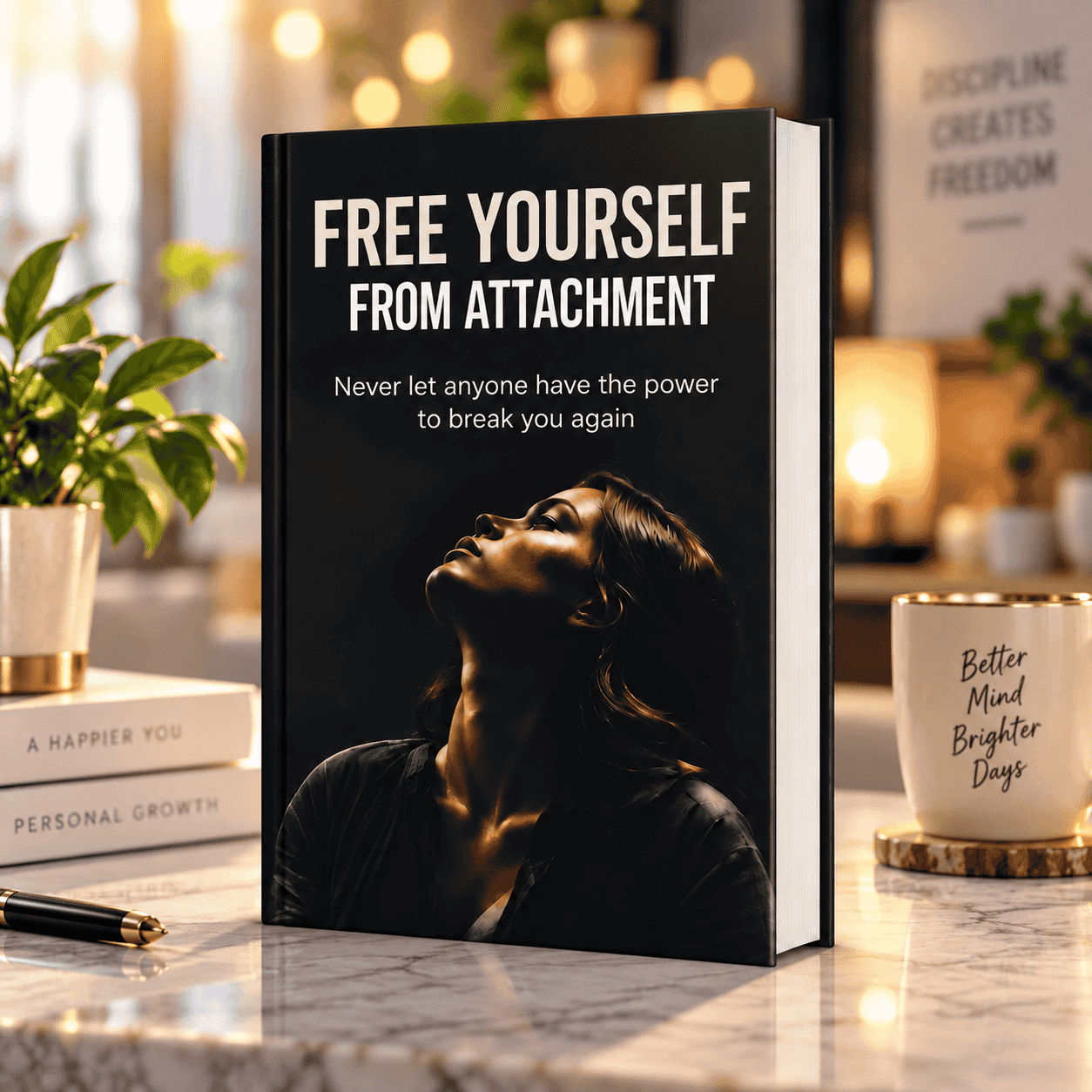
💎 The Unique Benefits of This Guide
FREE YOURSELF FROM ATTACHMENT isn't about teaching you how to stop caring.
It's about teaching you how to care without disappearing inside the relationship.
✅ Understand yourself better
Identify the emotional patterns that make you attach too deeply.
✅ Stop chasing validation
Build confidence that doesn't depend on someone's attention, affection or approval.
✅ Regain your emotional independence
Learn to feel secure even when someone is unavailable, distant or no longer part of your life.
✅ Protect your inner peace
Stop allowing messages, silence, rejection or relationship uncertainty to control your entire day.
✅ Learn to let go with dignity
Release people without destroying yourself in the process.
✅ Rebuild your identity
Reconnect with your goals, interests, confidence and personal direction.
✅ Create healthier relationships
Learn how to love deeply while maintaining boundaries, individuality and self-respect.
✅ Become harder to emotionally break
Not because you stop feeling…
but because you stop giving someone else complete control over what you feel.
🚀 Take action now
You have two choices.
You can continue doing what you've always done.
Keep checking.
Keep wondering.
Keep waiting.
Keep chasing.
Keep hoping that another person will finally give you the reassurance you're looking for.
Or…
You can start rebuilding your emotional freedom.
With FREE YOURSELF FROM ATTACHMENT, you'll have a structured guide to help you understand your attachment, regain your confidence, establish healthier boundaries and stop depending on another person for your sense of peace.
You don't need to become heartless.
You don't need to stop loving.
You simply need to stop losing yourself in the process of loving someone else.
👉 Download FREE YOURSELF FROM ATTACHMENT now
and start reclaiming your emotional freedom, your self-respect and your inner peace.
Customer Testimonials
Sarah ⭐⭐⭐⭐⭐
Je m’attachais beaucoup trop vite et je finissais toujours par donner une importance énorme à des personnes qui n’en donnaient pas autant en retour. Ce guide m’a vraiment aidée à prendre du recul et à mieux me respecter.
Michael ⭐⭐⭐⭐⭐
J’avais tendance à courir après les gens dès que je sentais une distance. J’ai compris que je pouvais tenir à quelqu’un sans devoir constamment chercher son attention. Aujourd’hui, je me sens beaucoup plus serein.
Jessica ⭐⭐⭐⭐
Ce que j’ai le plus apprécié, c’est que le guide ne dit pas simplement d’oublier une personne. Il explique pourquoi on s’attache autant et comment reprendre progressivement le contrôle de ses émotions.
David ⭐⭐⭐⭐⭐
J’ai réalisé que je faisais dépendre mon humeur des messages et de l’attention des autres. Après avoir appliqué plusieurs conseils du guide, je pense beaucoup moins à ce que les autres font et davantage à ma propre vie.
Emily ⭐⭐⭐⭐⭐
J’avais souvent peur de perdre quelqu’un alors que la relation n’était même pas vraiment équilibrée. Ce livre m’a aidée à comprendre que je n’avais pas besoin de me rabaisser pour être apprécié(e). Une vraie prise de conscience.
Daniel ⭐⭐⭐⭐⭐
Le passage sur l’estime de soi m’a particulièrement marqué. J’ai compris que le fait qu’une personne ne me choisisse pas ne signifie pas que je ne vaux rien. Je vois aujourd’hui les relations avec beaucoup plus de recul.
Olivia ⭐⭐⭐⭐⭐
Avant, quand quelqu’un s’éloignait, je faisais tout pour récupérer son attention. Maintenant, j’arrive davantage à prendre du recul et à me demander si cette relation est réellement bonne pour moi. Ça change énormément de choses.
James ⭐⭐⭐
Ce guide m’a surtout appris une chose : aimer quelqu’un ne signifie pas devoir se perdre soi-même. J’ai commencé à poser des limites et à arrêter de chercher constamment l’approbation des autres. Je recommande vraiment.